
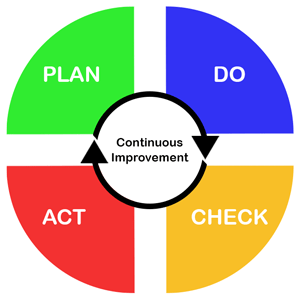
The Plan, Do, Check, Act (PDCA) cycle, also known as the Deming cycle or Shewhart cycle, is an integral part of Lean management. It is an iterative approach aimed at enabling organizations to achieve continuous improvement by systematically identifying and implementing changes. The PDCA cycle involves four key stages: planning (identifying the problem and developing a solution), implementing the plan, assessing the results, and finally, implementing the necessary adjustments based on the outcomes.
When it comes to Business Agility, PDCA has been embedded in frameworks that enable and improve organizational responsiveness. For instance, the Scaled Agile Framework for Enterprise (SAFe) 6.0 and Managing Successful Programmes (MSP) 5th edition both integrate PDCA principles to drive continuous improvement and foster agility within the organization. By leveraging PDCA for delivery, these frameworks facilitate adaptive and flexible approaches to deliver value.
The PDCA cycle can be applied to various aspects of program management, including risk analysis and management, issue resolution, stakeholder engagement, communications management, and information management. When applied to program management, the PDCA cycle helps identify potential risks, develop effective strategies for risk mitigation, engage stakeholders at various stages of the program, establish clear communication channels, and organize and manage program-related information effectively.
Programs establish new and improved capabilities to deliver benefits such as improved efficiency and effectiveness. The PDCA cycle offers a structured approach for ongoing improvement through multiple iterations over time. PDCA can be applied to programs and projects in the complicated domain. It’s important to know that the complex and chaotic domains have different characteristics according to the Cynefin framework. In these environments, other methods like Sensemaking and Probe-Sense-Respond may be necessary to effectively handle the challenges and uncertainties. Understanding the specific domain in which the program or project operates will help determine the approach to be used.
 DFORE PTY LTD - Value based consulting